Auschwitz death march
The Tattooist of AuschwitzThe Auschwitz death march is the brutal evacuation of the Birkenau and Auschwitz camps in the winter of 1944–45, a forced trek through ankle-deep snow that becomes a gauntlet of exhaustion, random gunfire, and mass death. For Gita Furman, the march is the final ordeal of her imprisonment, a nightmarish journey that separates her from Lale Sokolov and pushes her to the brink of death before a desperate act of flight saves her. It is the event that breaks the couple apart after years of survival together, and it stands as the starkest demonstration of how the Nazi regime's collapse still exacted a terrible toll on its prisoners. The march also reveals the resilience of human bonds, as Gita's friends and strangers alike risk their lives to keep her alive, and it sets the stage for the couple's eventual reunion in Bratislava.
The March Begins
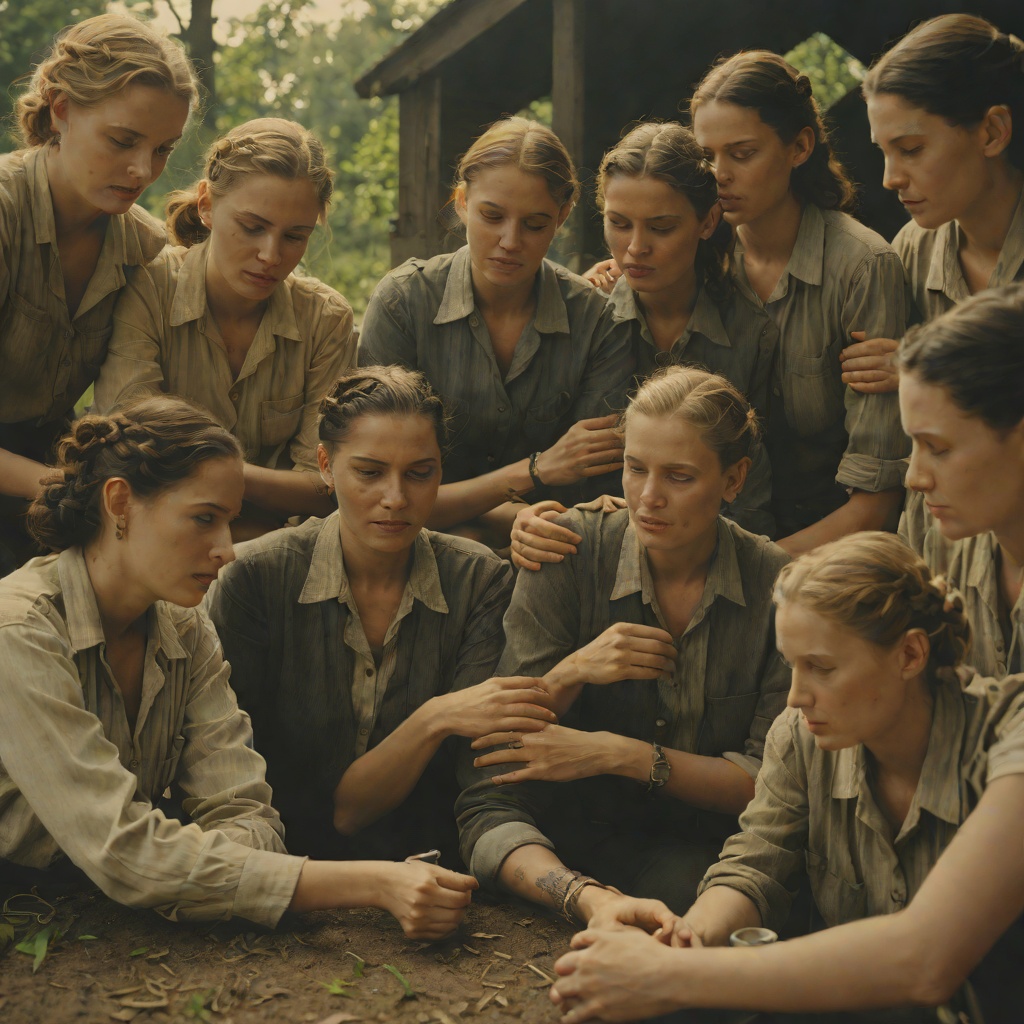
Gita and her friends are among thousands of women from Birkenau and Auschwitz forced onto a narrow track through ankle-deep snow, trudging forward as the SS guards watch for any sign of weakness. The women know that straggling is dealt with by a bullet, so they search the rows constantly, asking a hundred times, "Have you seen Cilka? Have you seen Ivana?" The answer is always the same. To support each other, they link arms, and at seemingly random times they are halted and told to rest; despite the cold, they sit in the snow, anything to give their feet some relief. Many remain there when the order to move on comes, dead or dying, unable to take another step. The march is a slow-motion massacre, where the prisoners themselves become the agents of their own attrition, and the SS need only wait for the cold and exhaustion to do their work.
Dana's Sacrifice
As day becomes night, the women's numbers dwindle, which only makes it harder to escape the watchful eye of the SS. During the night, Dana drops to her knees, unable to go on. Gita stops with her, and for a while they are unseen, screened by other women. Dana keeps telling Gita to go on, to leave her, but Gita protests, saying she would rather die here with her friend in a field somewhere in Poland. Four young girls offer to help carry Dana, but she will not hear of it; she tells them to take Gita and go. As an SS officer advances on them, the four girls pull Gita to her feet and drag her with them. Gita looks back at the officer, who has stopped beside Dana but moves on without drawing his pistol. No shot rings out; clearly he thinks she is already dead. The girls continue to drag Gita, refusing to let her go as she attempts to break free and get back to Dana. The scene is a devastating portrait of friendship and sacrifice, where Dana's refusal to endanger her friend becomes an act of love that Gita will carry with her, and where the SS officer's indifference to a dying woman is the only mercy she receives.
The Escape and the Polish Family
As day breaks, the women are brought to a halt in a field by a train track, where an engine and several cattle wagons stand waiting. Gita thinks, "They brought me here. Now they will take me away." Across the field stands a lone house, behind which a dense wood spreads out. The Polish girls turn to Gita and propose a desperate plan: "We're going to make a run for that house. If we get shot, then we will die here, but we're not going any farther. Do you want to come with us?" Gita stands up. Once the girls are running, they don't look back. The act of loading thousands of exhausted women onto the train takes all the guards' attention, and the door to the house is opened before they reach it. Inside, they collapse in front of a roaring fire, adrenaline and relief surging through them. Hot drinks are placed in their hands, along with bread. The Polish girls talk frantically to the homeowners, who shake their heads in disbelief. Gita says nothing, not wanting her accent to give away the fact that she isn't Polish; it's better their saviors think she is one of them, the quiet one. The man of the house says they can't stay, as the Germans often search the premises. He tells them to take their coats off, takes them out behind the house, and when he returns, the red slashes are gone and the coats smell of petrol. The escape is a masterful act of timing and luck, but it is also a testament to the courage of ordinary people who risked everything to shelter fugitives, and to Gita's own instinct for survival, her silence as much a weapon as the girls' boldness.
The Night in the Woods and the Journey Onward
Outside, they hear repeated shooting, and peering through the curtains, they watch as all the surviving women are finally herded onto the train. Bodies litter the snow beside the tracks. The man gives the girls the address of a relative in a nearby village, as well as a supply of bread and a blanket. They leave the house and enter the woods, where they spend the night on the freezing ground, curled up together in a vain attempt to stay warm. The bare trees provide little in the way of protection, either from being seen or from the elements. It is early evening before they arrive in the next village; the sun has gone down, and the weak streetlamps cast little light. They are forced to ask a passerby for help finding the address they have been given, and the kind woman takes them to the house they seek and stays with them while they knock on the door. The night in the woods is the rawest expression of their newfound freedom, a freedom that is cold, hungry, and terrifying, yet infinitely preferable to the march. The kindness of the passerby, like that of the family, underscores the novel's theme that humanity persists even in the darkest times, and that survival is often a collective act.
Historical Context and Aftermath
The death march is the culmination of the Nazi regime's final efforts to evacuate the camps as the Allies advanced, and it is a historical event that the novel renders through Gita's personal ordeal. The march separates Gita from Lale, who is himself evacuated from Birkenau and later escapes from the Saurer-Werke subcamp, and it is only after the war that the couple is reunited in Bratislava. The event also resonates with the broader history of the Holocaust, as documented in the novel's additional information: Lale was transported to Auschwitz on April 23, 1942, and tattooed with the number 32407, while Gita was transported on April 13, 1942, and tattooed with the number 34902. The march's aftermath is one of loss and survival, as many prisoners died on the road or in the trains that followed, and the survivors, like Gita, were left to rebuild their lives in a world that had been shattered. The novel's author reflects that Lale's memories "waltzed perfectly in step" with history, and the death march is one of those moments where personal memory and historical fact converge, a testament to the endurance of the human spirit in the face of unimaginable cruelty.